
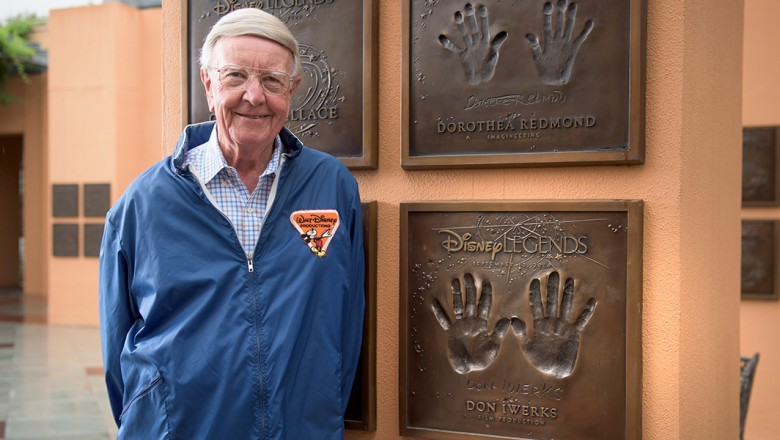
Disney has lost one of the innovators whose groundbreaking work helped transform movies and theme park attractions for generations.

Guests may not always recognize Don Iwerks’ name while walking through Disneyland, Magic Kingdom, or EPCOT, but they have almost certainly experienced the results of his imagination. From the development of Disney’s Circle-Vision camera system to the technology behind Captain EO, Star Tours, Mary Poppins, and some of EPCOT’s most ambitious opening-day presentations, Iwerks helped make seemingly impossible ideas a reality.
Disney Legend Don Iwerks died during the evening of July 9th, 2026, at the age of 96, according to The Walt Disney Company.
Iwerks was a pioneer in the development of camera equipment, projection technology, special photographic processes, and other technical systems used throughout Disney films and theme parks. His career with the company lasted approximately 35 years and placed him behind some of Disney’s most important technological achievements.

In a statement honoring Iwerks, Walt Disney Company CEO Josh D’Amaro said his combination of ingenuity, passion, and heart reflected the qualities that have long defined Disney. D’Amaro also credited Iwerks’ innovations with helping create iconic films and attractions enjoyed by generations of fans around the world.
Don Iwerks Followed His Father Into Disney History
Don Iwerks was born on July 24th, 1929, and followed his father, legendary animator and special-effects innovator Ub Iwerks, into the Walt Disney organization.
Ub Iwerks was one of Walt Disney’s earliest collaborators and became an essential figure in the company’s animation and technical history. Like his father, Don would eventually earn recognition as a Disney Legend for his own contributions to filmmaking and themed entertainment.

Don joined Walt Disney Productions in 1950 as a special photographic processes laboratory technician. His first period at the company was brief, however, because he was drafted during the Korean War. He served for two years in the Signal Photo Corps before returning to the United States and immediately resuming his Disney career.
In January 1953, Iwerks transferred to the Walt Disney Studio Machine Shop. He was eventually offered a position as a camera technician and began working on his first major Disney film project, 20,000 Leagues Under the Sea, released in 1954.
Over time, Iwerks rose through Disney’s technical departments and eventually led the Machine Shop, Camera Service Department, and Technical Engineering and Manufacturing Division.
Those roles placed him at the center of Disney’s efforts to develop new cameras, projection systems, film formats, and attraction technology that could bring Walt Disney’s increasingly ambitious ideas to life.
Don Iwerks Helped Develop Disney’s Circle-Vision Camera
One of Don Iwerks’ most influential accomplishments was helping develop Disney’s 360-degree Circle-Vision camera system.
The technology was first used inside the Circarama, U.S.A. attraction when Disneyland opened in 1955. Its first film, A Tour of the West, was displayed using eleven 16mm projectors arranged around the theater. Later Circle-Vision presentations used nine projectors.

Instead of watching a movie on one traditional screen, guests stood inside a theater surrounded by projected images. The system created an immersive panoramic experience that allowed audiences to look in nearly every direction.
Iwerks later taught an Italian film crew how to operate the unusual camera for Italia ’61, a production created for an exposition in Turin, Italy.
Circle-Vision Became Part of Disneyland, Magic Kingdom, and EPCOT
One of Disney’s best-known early Circle-Vision films was America the Beautiful.
Multiple versions of the film played at Disneyland for more than 17 years. The presentation was also shown at Magic Kingdom in Walt Disney World before a newly filmed Circle-Vision 360 version eventually appeared at EPCOT Center, Tokyo Disneyland, and Disneyland Paris.
That technology became an important part of Disney theme park history, particularly in areas focused on travel, culture, and large-scale cinematic storytelling.

For longtime Walt Disney World fans, Circle-Vision may be most closely associated with EPCOT attractions such as the Canada and China pavilion films. Although those presentations have evolved over the years, they were built upon the technical foundation developed by innovators including Don Iwerks.
EPCOT Was One of His Most Meaningful Projects
Iwerks frequently described his work at the 1964 –1965 New York World’s Fair and EPCOT Center as defining moments in his career.
EPCOT’s original attractions required complex projection systems on a scale rarely attempted inside theme parks. The park included two nine-screen Circle-Vision theaters, while the France pavilion used five screens to create an approximately 200-degree panoramic presentation inside a seated theater.

The American Adventure also relied on a massive rear-projection system positioned behind physical sets and Audio-Animatronic scenes. Iwerks said the combination of film, scenery, and storytelling made the attraction one of EPCOT’s most powerful experiences.
Don Iwerks’ Disney accomplishments extended far beyond Circle-Vision.

He helped build and develop specialized film equipment used for Disney’s attractions at the 1964 –1965 New York World’s Fair. He later engineered 3D film technology and in-theater effects for Captain EO, the Michael Jackson-led attraction that premiered at EPCOT and Disneyland in 1986.
Iwerks also built the projection system used for the original Star Tours, which combined a motion simulator with synchronized film footage to transport guests into the Star Wars universe.
These projects helped advance the idea that a theme park film could become more than something audiences simply watched. Through synchronized movement, projection, physical effects, and immersive theater design, the movie could become an attraction that guests felt as though they had entered.
Iwerks also worked alongside his father to develop and refine Disney’s sodium vapor process.

The special-effects technique used specialized cameras and optical printers to combine live-action performers with painted backgrounds and traditional animation. It was famously used in Disney’s 1964 film Mary Poppins, including the “Jolly Holiday” sequence in which Mary, Bert, and the children enter an animated world.
The process helped Mary Poppins create visual effects that appeared remarkably seamless for the era. The film ultimately won the Academy Award for Best Visual Effects, among its five Oscar victories.
His Work Earned Recognition From the Academy
In 1997, Don Iwerks received the Gordon E. Sawyer Award from the Academy of Motion Picture Arts and Sciences’ Board of Governors.
The honorary award recognized his contributions to the motion-picture industry through large-format filmmaking, simulated-film experiences, and other technical innovations.
Iwerks was later inducted as a Disney Legend during the inaugural D23 Expo in 2009. His handprints, along with those of his father, can be found at Legends Plaza on the Walt Disney Studios lot in Burbank, California.
Don and Ub Iwerks Share a Window at Magic Kingdom
Don Iwerks and his father also share a special tribute inside Magic Kingdom.
A window on Main Street, U.S.A. bears the name “Iwerks–Iwerks Stereoscopic Cameras,” recognizing the father-and-son innovators and their extraordinary contributions to Disney’s technical history.
The windows displayed above Main Street’s shops traditionally honor individuals who played important roles in building The Walt Disney Company and its theme parks. For Disney history fans, the Iwerks window is a reminder that many of the company’s most memorable experiences were made possible by inventors and technicians working behind the scenes.
Iwerks Continued Innovating After Leaving Disney
After approximately 35 years with Disney, Don Iwerks left the company and formed Iwerks Entertainment, Inc. in 1986.
The company specialized in giant-screen theaters, large-format filmmaking, simulation technology, and 3D projection-based theme park attractions. Iwerks Entertainment was later acquired by SimEx, Inc. in 2001.
His influence therefore continued well beyond Disney, helping shape immersive theater and attraction experiences throughout the broader themed-entertainment industry.
The Iwerks Family’s Disney Legacy Spans Generations
Few families have influenced Disney history as profoundly as the Iwerks family.
Ub Iwerks helped establish the company’s early artistic and technical identity. Don Iwerks continued that legacy through revolutionary camera, projection, and attraction systems. Don’s daughter Leslie Iwerks has also helped preserve Disney history through documentary films and books, including projects examining Walt Disney Imagineering and her grandfather’s career.
Don Iwerks is survived by his wife of 54 years, Betty; his sons, John and Larry; and his daughter, Leslie. He was preceded in death by his daughter Tamara.
Remembering a Disney Theme Park Innovator
Don Iwerks may have spent much of his career working behind cameras, projectors, and complex pieces of machinery, but the experiences he helped create were seen and enjoyed by millions.
His innovations brought panoramic landscapes to Circle-Vision theaters, helped live-action performers step into animated worlds, added physical effects to 3D movies, and transported theme park guests into entirely different places.
The next time you notice the immersive screens inside a Disney attraction, watch an old Circle-Vision film, pass the Iwerks window on Main Street, U.S.A., or revisit classics such as Mary Poppins, you are seeing part of the remarkable legacy he left behind.
Be sure to revisit Theme Park Scope for more Disney history, Walt Disney Imagineering news, theme park entertainment updates, Disney attraction stories, and the latest developments from Disney and Universal.


Leave a Reply